Close Menu
Cryphedge.com
  • Home
  • Crypto News
    • Bitcoin
    • NFT News
  • Altcoins
  • Scams
  • Blockchain
  • Regulations
  • Trading
Facebook X (Twitter) Instagram
Cryphedge.com
  • Home
  • Crypto News
    • Bitcoin
    • NFT News
  • Altcoins
  • Scams
  • Blockchain
  • Regulations
  • Trading
Cryphedge.com
Home » Stablecoin regulation converts issuers into psuedo-banks while adding a barrier to entry for smaller players
Stablecoin regulation converts issuers into psuedo-banks while adding a barrier to entry for smaller players

Stablecoin regulation converts issuers into psuedo-banks while adding a barrier to entry for smaller players

June 21, 20265 Mins ReadNo Comments Regulations
Share
Facebook Twitter LinkedIn Pinterest Email

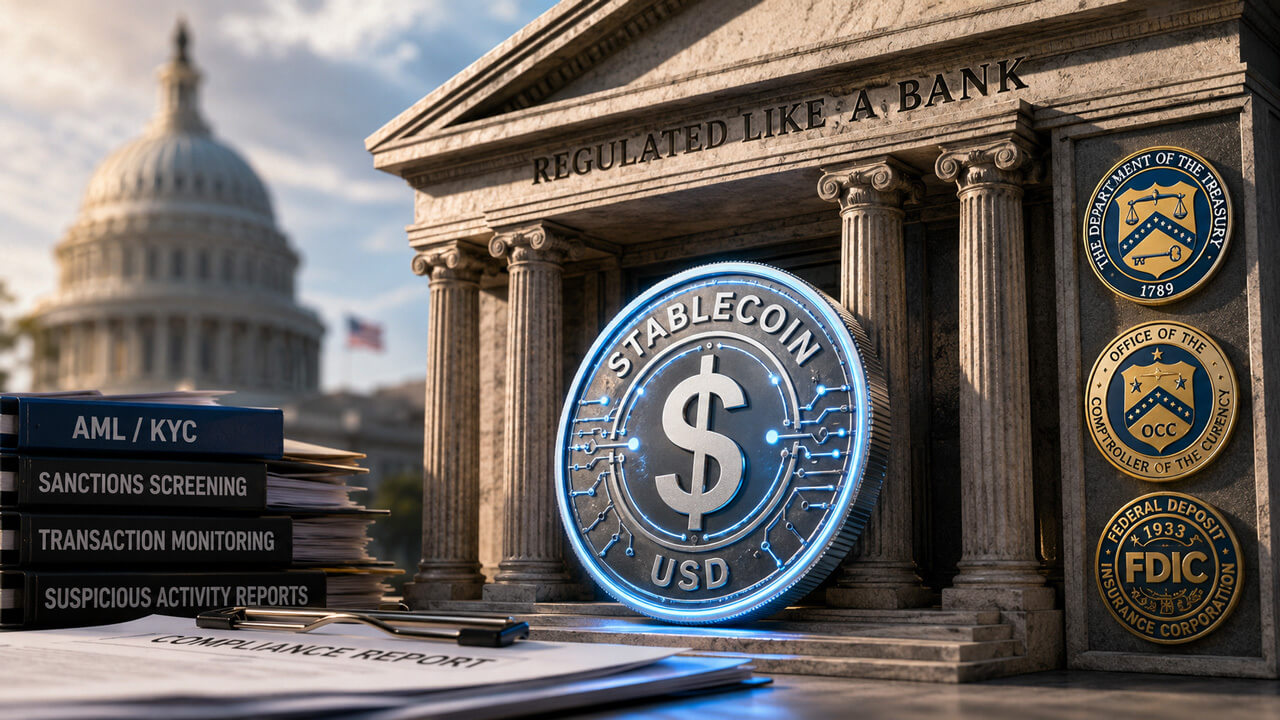
Three federal agencies have proposed rules that would make stablecoin issuers operate like banks. The Treasury wants them to run anti-money-laundering and sanctions programs.

The Office of the Comptroller of the Currency (OCC) wants a weekly confidential report and a quarterly financial report from each one, and the Federal Deposit Insurance Corporation (FDIC) wants Bank Secrecy Act obligations applied to the issuers it supervises.

If adopted, these proposals will turn the issuance of a dollar-pegged token into a job that requires customer screening, transaction monitoring, suspicious activity reporting, reserve disclosures, and a steady stream of data to a primary regulator.

The next phase of stablecoin regulation is therefore less about permission to issue a token and more about whether an issuer can carry the cost of being supervised like a financial institution.

Much of this formalizes what large issuers already do. But for smaller ones, the compliance burden will become the biggest barrier to entering a market now worth roughly $320 billion. The legal clarity the industry spent years fighting for came with an operating cost that decides who can realistically compete.

The GENIUS Act, signed into law in July 2025, is the federal framework for payment stablecoins, the dollar-pegged tokens designed to maintain a steady value and facilitate payments and settlement. It lets a company issue these tokens only as a “permitted payment stablecoin issuer,” or PPSI, meaning payment stablecoin issuers must be cleared by regulators under the federal regime.

Treasury opened the rulemaking that fills in the details in late 2025, and the proposals landing through 2026 are where that permission will become a working compliance regime.

Stablecoin issuers are turning into compliance companies

A stablecoin issuer’s product looks simple, since one token is meant to equal one dollar, but the regulated version carries a long operational tail.

Stablecoin compliance now means teams and systems to identify customers, monitor transactions, screen wallets and counterparties against sanctions lists, flag suspicious behavior, and document all of it for an examiner. The work moves from the edge of a crypto company to the center of the business.

That change in demands took shape in April 2026, when the Treasury’s FinCEN and OFAC issued a joint proposed rule that would treat permitted issuers as financial institutions under the Bank Secrecy Act and, for the first time, require a category of US persons to maintain an effective sanctions-compliance program.

The FDIC followed on May 22 with a parallel rule for the issuers it supervises, the ones that operate as subsidiaries of state nonmember banks and state savings associations.

All of this changes the cost structure of the business. The competitive edge moves toward compliance capacity, so issuers that can afford lawyers, transaction-monitoring vendors, reporting systems, and durable banking relationships hold an advantage over newcomers building the same machinery from scratch.

The supervision side became concrete in June 2026, when the OCC published draft reporting forms for issuers under its jurisdiction. Each issuer would file a weekly confidential report on every stablecoin it issues, covering issuance, redemptions, trading volume, and reserve assets, plus a quarterly report on financial conditions that looks much like the call reports that national banks file.

Issuers with more than $50 billion outstanding would also produce audited annual financial reports, and the OCC would examine each one at least once every 12 months. Weekly data gives regulators early insight into reserve problems or redemption stress, and it turns a token project into a continuously monitored financial company.

CryptoSlate Daily Brief

Daily signals, zero noise.

Market-moving headlines and context delivered every morning in one tight read.

5-minute digest 100k+ readers

Free. No spam. Unsubscribe any time.

Whoops, looks like there was a problem. Please try again.

You’re subscribed. Welcome aboard.

The market is getting smaller and more institutional

The same framework limits how regulated issuers can compete for users. The GENIUS Act bars permitted issuers from paying holders any interest or yield on the token, and the OCC proposal carries that ban into its rules, reserving scrutiny for affiliate arrangements designed to circumvent it.

Yield has been one of crypto’s strongest tools for winning users, so issuers that can’t pay it directly will instead compete on liquidity, integrations, payment utility, and institutional access.

Put those costs together, and the result is likely to be consolidation. Large issuers can absorb compliance costs, build reporting systems, hire former regulators, and retain their banking partners, while smaller ones may struggle to justify the expense unless they serve a defined niche or partner with a larger regulated platform.

A state-chartered nonbank issuer that crosses $10 billion in circulation would generally have to move to a federal license, so scale itself would pull issuers toward federal supervision. The FDIC estimates that five to 30 of the institutions it supervises could win approval to issue through subsidiaries in the framework’s first few years.

That smaller field comes with a tradeoff between credibility and flexibility. A regulated stablecoin will be more attractive to banks, brokers, payment companies, and corporate treasuries because it will have clear rules and a familiar regulator. The same oversight makes the token resemble a tokenized layer of the existing banking system more than the open financial infrastructure early advocates described.

The companies that will benefit from this are those that already understand how supervised institutions work, which is part of why Tether has moved toward a compliant US product called USAT, while Circle has leaned further into its regulated posture.

The GENIUS Act stablecoin rules were framed as a breakthrough for the sector, and they remain one.. Its implementation phase shows that legal clarity comes with a supervisory regime attached, and the next stage of growth will depend less on issuing a token and more on proving an issuer can survive inside the financial system.

The companies that manage it may become core dollar infrastructure for banks and businesses, while the ones that can’t carry the load may be regulated out of the race before the framework takes full effect in 2027.

Share. Facebook Twitter Pinterest LinkedIn Tumblr Email

cryphedge

Related Posts

FCC robocall rule could make phone accounts a richer target for crypto attackers

June 21, 2026

Morgan Stanley’s proposed 0.14% ETH and SOL fees could turn the next crypto ETF race into a price fight

June 21, 2026

Texas questions whether AI data centers should pay for the grid they strain

June 20, 2026

CME lawsuit challenges whether Kalshi’s Bitcoin leverage push can become an everything-exchange

June 19, 2026
Add A Comment
Leave A Reply Cancel Reply

Editors Picks

Africa’s crypto crackdown is really a remittance revolution

June 21, 2026

Morpho’s $175M Raise: Is On-Chain Credit Still Fundable After DeFi’s Liquidity Stress?

June 21, 2026

BTC Eyes Upside as Franklin Templeton Pushes Stock Dividends

June 21, 2026

FCC robocall rule could make phone accounts a richer target for crypto attackers

June 21, 2026
About

cryphedge is an online news portal that aims to share the latest crypto news, bitcoin, altcoin, blockchain, nft news, regulation, trading, crypto scams and much more stuff.

Facebook X (Twitter) Instagram Pinterest YouTube
Top Insights

Massive Dogecoin Upside Ahead? Breakout Target Hints at 111% Surge

September 18, 2025

XRP Records Over 21,000 New Wallets in 48 Hours

November 7, 2025

The 1099-DA Problem: What's Missing From Your Crypto Tax Form

March 24, 2026
Subscribe
Please enable JavaScript in your browser to complete this form.
Loading
  • Contact Us
  • Disclaimer
  • Privacy Policy
  • Terms of Use
  • DMCA

Type above and press Enter to search. Press Esc to cancel.

  • bitcoinBitcoin(BTC)$63,435.00-1.19%
  • ethereumEthereum(ETH)$1,709.48-1.70%
  • tetherTether(USDT)$1.000.00%
  • binancecoinBNB(BNB)$584.70-0.38%
  • usd-coinUSDC(USDC)$1.000.02%
  • rippleXRP(XRP)$1.13-1.95%
  • solanaSolana(SOL)$72.83-0.57%
  • tronTRON(TRX)$0.3278090.46%
  • Figure HelocFigure Heloc(FIGR_HELOC)$1.030.00%
  • HyperliquidHyperliquid(HYPE)$66.90-5.60%
  • dogecoinDogecoin(DOGE)$0.082468-1.48%
  • USDSUSDS(USDS)$1.000.01%
  • RainRain(RAIN)$0.014364-0.54%
  • leo-tokenLEO Token(LEO)$9.55-0.14%
  • zcashZcash(ZEC)$442.74-6.36%
  • stellarStellar(XLM)$0.210622-2.50%
  • WhiteBIT CoinWhiteBIT Coin(WBT)$52.18-1.14%
  • moneroMonero(XMR)$319.33-1.09%
  • cardanoCardano(ADA)$0.158133-3.14%
  • chainlinkChainlink(LINK)$7.80-2.23%
  • CantonCanton(CC)$0.149748-1.82%
  • USD1USD1(USD1)$1.000.01%
  • LABLAB(LAB)$15.1212.79%
  • Ethena USDeEthena USDe(USDE)$1.000.00%
  • Gram (prev. Toncoin)Gram (prev. Toncoin)(GRAM)$1.650.93%
  • daiDai(DAI)$1.00-0.02%
  • bitcoin-cashBitcoin Cash(BCH)$195.81-1.98%
  • MemeCoreMemeCore(M)$2.912.26%
  • litecoinLitecoin(LTC)$44.570.21%
  • hedera-hashgraphHedera(HBAR)$0.078275-2.85%
  • Circle USYCCircle USYC(USYC)$1.130.00%
  • suiSui(SUI)$0.70-2.57%
  • Global DollarGlobal Dollar(USDG)$1.000.00%
  • PayPal USDPayPal USD(PYUSD)$1.000.05%
  • shiba-inuShiba Inu(SHIB)$0.000005-1.95%
  • nearNEAR Protocol(NEAR)$2.10-4.00%
  • crypto-com-chainCronos(CRO)$0.058421-0.74%
  • avalanche-2Avalanche(AVAX)$6.12-1.88%
  • tether-goldTether Gold(XAUT)$4,140.02-0.04%
  • BlackRock USD Institutional Digital Liquidity FundBlackRock USD Institutional Digital Liquidity Fund(BUIDL)$1.000.00%
  • BittensorBittensor(TAO)$229.40-1.48%
  • Ondo US Dollar YieldOndo US Dollar Yield(USDY)$1.13-0.23%
  • WorldcoinWorldcoin(WLD)$0.61-0.45%
  • World Liberty FinancialWorld Liberty Financial(WLFI)$0.0596903.07%
  • pax-goldPAX Gold(PAXG)$4,148.68-0.01%
  • uniswapUniswap(UNI)$2.98-1.10%
  • mantleMantle(MNT)$0.53-1.09%
  • AsterAster(ASTER)$0.64-1.24%
  • Ripple USDRipple USD(RLUSD)$1.00-0.03%
  • OndoOndo(ONDO)$0.331598-3.57%
  • okbOKB(OKB)$76.491.62%
  • polkadotPolkadot(DOT)$0.94-2.82%
  • HTX DAOHTX DAO(HTX)$0.0000020.11%
  • Pi NetworkPi Network(PI)$0.1352720.73%
  • Falcon USDFalcon USD(USDF)$1.000.01%
  • SkySky(SKY)$0.0590461.69%
  • usddUSDD(USDD)$1.000.01%
  • BFUSDBFUSD(BFUSD)$1.000.00%
  • internet-computerInternet Computer(ICP)$2.21-3.82%
  • bitget-tokenBitget Token(BGB)$1.75-1.17%
  • PepePepe(PEPE)$0.000003-1.49%
  • MorphoMorpho(MORPHO)$1.80-1.32%
  • ethereum-classicEthereum Classic(ETC)$7.32-2.08%
  • aaveAave(AAVE)$73.72-3.64%
  • quant-networkQuant(QNT)$70.300.02%
  • United StablesUnited Stables(U)$1.000.00%
  • Invesco Short Duration US Government Securities FundInvesco Short Duration US Government Securities Fund(USTB)$11.120.00%
  • Blockchain CapitalBlockchain Capital(BCAP)$107.070.00%
  • kucoin-sharesKuCoin(KCS)$7.230.09%
  • Spiko EU T-Bills Money Market FundSpiko EU T-Bills Money Market Fund(EUTBL)$1.21-0.08%
  • USDtbUSDtb(USDTB)$1.000.05%
  • cosmosCosmos Hub(ATOM)$1.76-2.71%
  • Janus Henderson Anemoy Treasury FundJanus Henderson Anemoy Treasury Fund(JTRSY)$1.110.00%
  • render-tokenRender(RENDER)$1.66-3.80%
  • POL (ex-MATIC)POL (ex-MATIC)(POL)$0.079061-1.32%
  • EthenaEthena(ENA)$0.087604-2.31%
  • ​​Stable​​Stable(STABLE)$0.033901-0.57%
  • kaspaKaspa(KAS)$0.029249-1.84%
  • algorandAlgorand(ALGO)$0.089615-4.69%
  • nexoNEXO(NEXO)$0.78-1.79%
  • Janus Henderson Anemoy AAA CLO FundJanus Henderson Anemoy AAA CLO Fund(JAAA)$1.040.00%
  • justJUST(JST)$0.0836130.07%
  • gatechain-tokenGate(GT)$6.69-0.24%
  • JupiterJupiter(JUP)$0.2141181.94%
  • 币安人生 (BinanceLife)币安人生 (BinanceLife)(币安人生)$0.70-1.27%
  • Venice TokenVenice Token(VVV)$14.912.75%
  • DeXeDeXe(DEXE)$14.31-6.95%
  • FlareFlare(FLR)$0.007409-0.27%
  • filecoinFilecoin(FIL)$0.79-0.12%
  • BeldexBeldex(BDX)$0.079520-1.16%
  • GHOGHO(GHO)$1.000.00%
  • xdce-crowd-saleXDC Network(XDC)$0.029437-0.63%
  • YLDSYLDS(YLDS)$1.00-0.01%
  • Spiko Amundi Overnight Swap Fund (EUR)Spiko Amundi Overnight Swap Fund (EUR)(EURSAFO)$1.15-0.08%
  • MidnightMidnight(NIGHT)$0.0333023.84%
  • Usual USDUsual USD(USD0)$1.00-0.01%
  • aptosAptos(APT)$0.650.63%
  • arbitrumArbitrum(ARB)$0.082057-3.15%
  • ADIADI(ADI)$4.172.95%
  • Pump.funPump.fun(PUMP)$0.0014732.85%