SEC Commissioner Hester Peirce has warned that crypto vaults may face federal securities-law scrutiny when people control how assets earn yield.
Morpho Vault V2 offers a clear case study because its architecture divides the same powers Peirce highlighted. Curators choose the strategy and appoint allocators, while allocators move assets within those limits.
Morpho is a decentralized lending protocol, and Vault V2 packages curated lending strategies into onchain vaults. Users interact with smart contracts, but curators still decide where capital can go and how much risk the vault can take.
If regulators view that human control as financial management, the consequences could reach the teams running a wider class of DeFi yield products.

In a July 22 statement, Peirce placed crypto vaults on a spectrum. Some run on immutable code; others give people the wheel. Federal securities-law questions emerge when managers choose yield routes and shift assets. Even deciding who gets that authority can matter.
Peirce addressed vaults generically. Her statement named no protocol, including Morpho, and was not a Commission rule, order or enforcement action. She said the legal result would depend on the structure and activities of a particular vault.
Who controls Morpho Vault V2?
In Morpho Vault V2, the curator draws the map. The role decides which protocols, markets, and assets the vault can use, opens those routes through adapters, and sets the risk limits. The curator also chooses the allocators who move assets within those lines.
Those powers correspond to two of Peirce’s examples: selecting available yield routes and selecting the parties that make allocation decisions. Morpho also gives curators control over performance and management fees, fee recipients, and optional compliance gates, although Peirce did not identify vault fee-setting as a standalone trigger.

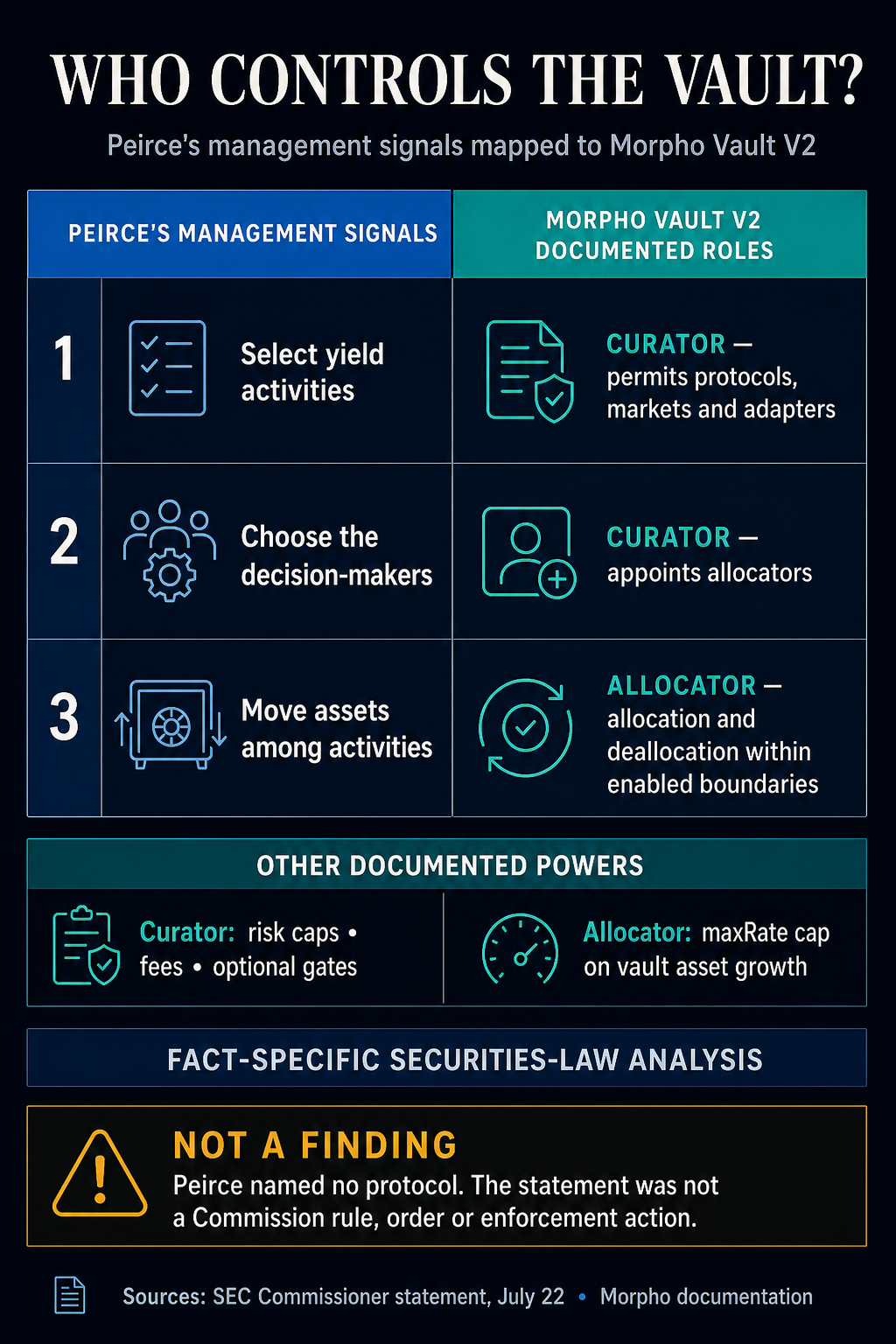
Morpho’s role design places daily execution elsewhere. Allocators perform routine allocation and deallocation among enabled adapters. They can also set maxRate, which Morpho describes as the maximum rate at which vault assets can grow. The documentation does not equate that control with setting a borrower’s interest rate or give the Vault V2 curator direct authority over underlying loan-to-value limits or liquidation thresholds, which Peirce discussed separately for lending strategies.
Even when the contract code is immutable, the portfolio can keep moving. Curators can update the settings that shape the vault. Actions that add risk usually pass through function-specific timelocks, sometimes set to zero. Cap cuts and sentinel interventions can happen immediately. Through abdication, a curator can permanently switch off selected timelocked powers.
That distribution of control could affect which of Peirce’s analogies fits. She said some vaults may resemble fixed unit investment trusts, others management investment companies, and others separately managed accounts. Involvement in managing vaults or lending strategies may also raise investment-adviser issues, she said.

For Morpho Vault V2, the relevant facts would include the assets a vault holds, the configuration powers that remain active, and how curators and allocators exercise their separate roles. Peirce’s statement raises those questions without answering them for Morpho.