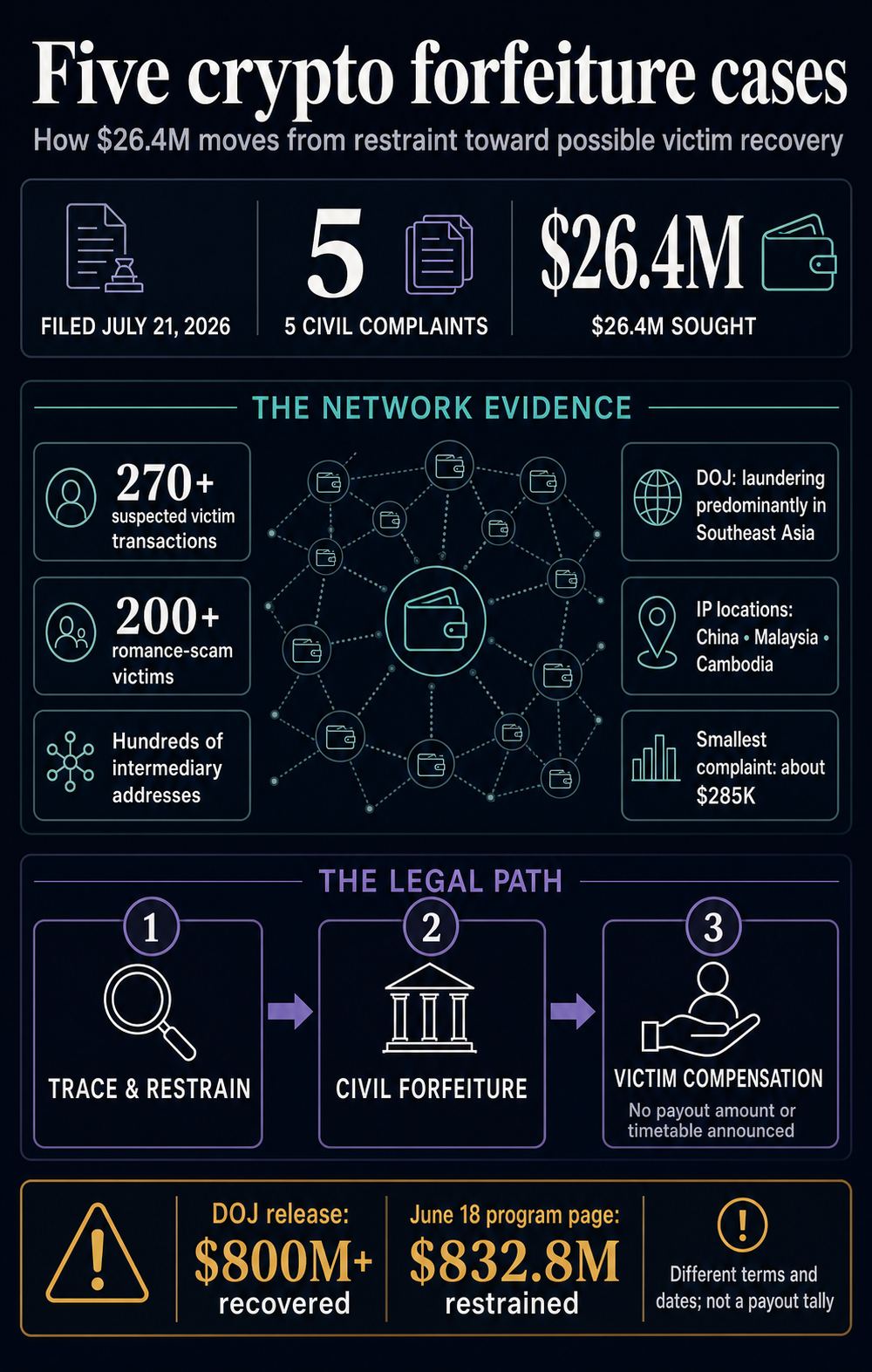
U.S. prosecutors filed five civil-forfeiture complaints on July 21 seeking roughly $26.4 million in cryptocurrency traced through separate international fraud investigations.
Investigators can freeze suspected criminal proceeds before they know who is behind the scheme. They can then seek forfeiture while the search for suspects continues, with any final seizure and repayment to victims decided later.
The U.S. Attorney’s Office for the District of Columbia said one investigation traced more than 270 suspected victim transactions involving fraudulent investment platforms. Another involved more than 200 romance-scam victims and hundreds of intermediary addresses used to commingle funds.
Across all five cases, DOJ said launderers were predominantly located in Southeast Asia, with associated IP addresses in China, Malaysia, and Cambodia.
The fifth and smallest case shows the danger of repeat victimization. A person who had already lost money to an unrelated fraud was then contacted by scammers claiming they had recovered the stolen funds.
The victim paid a fee and sent a series of transactions before investigators traced some of those transactions. The complaint seeks about $285,000, and efforts to recover additional funds are continuing.
From restraint to restitution
A freeze is intended to prevent identified cryptocurrency from moving. A civil-forfeiture complaint starts the next legal step by asking a court to transfer ownership of the property to the government.
DOJ says civil judicial forfeiture proceeds against the property and does not require a criminal conviction. Still, prosecutors must prove its connection to criminal activity by a preponderance of the evidence. Filing a complaint therefore does not complete forfeiture or establish anyone’s criminal guilt.

DOJ described the five seizures as part of more than $800 million recovered through the Scam Center Strike Force.
A strike force program page, updated June 18, reported a different measure: $832.8 million in cryptocurrency restrained. The figures use different terms and dates, so they are not a before-and-after comparison or a victim payout tally. They show that the assets DOJ reports as recovered or restrained have reached the hundreds of millions of dollars, while leaving their final disposition unresolved.
Recovering the money does not automatically put it back in victims’ hands. Qualifying victims may later receive forfeited assets through DOJ’s remission or restoration process, which can also send funds to courts for restitution.
The July 21 announcement gave no distribution amount, eligible claimant list, or timetable for these five cases. What remains unresolved is whether the courts grant forfeiture, whom investigators ultimately identify, and how much of the cryptocurrency at issue eventually reaches victims.