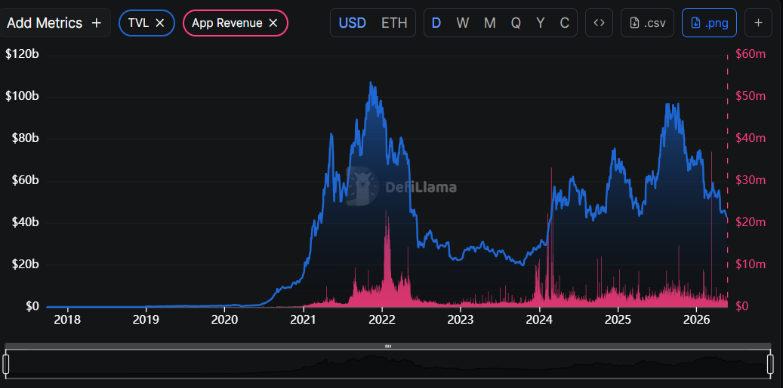
- Ethereum’s stablecoin market capitalization has soared over $164 billion, thanks to growing adoption and regulatory developments.
- Despite the surge in the stablecoin’s market cap, Ethereum is still facing a revenue-related issue after the Dencun upgrade.
- The approval of the GENIUS Act in 2025 and the progress in the CLARITY Act have boosted the confidence of major financial institutions and banks to integrate digital assets into their existing infrastructure.
Amid the positive regulatory developments and growing adoption of stablecoins by traditional players, Ethereum has witnessed an impressive jump in the stablecoin market capitalization, soaring over $164 billion on May 23, 2026.
(Source: DeFiLlama)
The staggering market capitalization of stablecoin on Ethereum makes it the biggest blockchain network for stablecoin, as it holds more than 50% market share of the total market capitalization of $323 billion. This makes it the biggest settlement layer for dollar-pegged stablecoins by outperforming Tron and other chains.
Ethereum-based Stablecoins See Growth in Adoption After Approval of GENIUS Act
The surge in the stablecoin market cap is coming after its growing integration into the traditional finance sector, as it provides numerous benefits. In the last few months, big institutions have selected the Ethereum network for their operations because of its strong security, liquidity, etc.
Major stablecoin issuers like Tether for USDT and Circle for USDC are using Ethereum as their main network. USDT is the biggest USD-pegged stablecoin right now, which has around $189 billion in market capitalization as it is being used for various purposes such as payments, cross-border remittances, decentralized finance, and tokenized real-world assets.
Apart from its adoption, the major developments in the regulatory framework for digital assets have played a major role in boosting the confidence of financial institutions. Last year, U.S. President Donald Trump officially signed the GENIUS Act and turned it into the first federal law for the stablecoin market. This moment has triggered an excitement in the digital asset industry, and many major financial institutions from the traditional finance world have started rushing to integrate digital assets into their existing infrastructure.
Major payment companies such as Visa, Stripe, through its Bridge acquisition, and PayPal have also integrated stablecoin to maintain their dominance in the digital payment ecosystem by adopting new generation innovations. The majority of these entities are using Ethereum as a main blockchain network.
For example, PayPal’s native stablecoin, which is known as PYUSD, is available on Ethereum along with other blockchains. Similarly, Coinbase launched its stablecoin as a service player in 2025, which also allows users to integrate Ethereum. This platform allows users to create and issue their own branded stablecoins that are backed by USDC. After the launch, there are many partners who have joined this project, including Flipcash.
Amid the boom in the stablecoin market, the banking sector has also expressed its interest in adopting the digital dollars available on the blockchain. Financial giants like BlackRock are rapidly developing infrastructure to integrate stablecoins to settle transactions. In a similar trend, JPMorgan and other banks are also doing their experiments with deposit tokens and on-chain treasury solutions.
Ethereum Network Sees Growth, But Revenue Stalls
The surge in the stablecoin market cap on the blockchain network comes after it recorded its highest number of transactions in a single day in April.
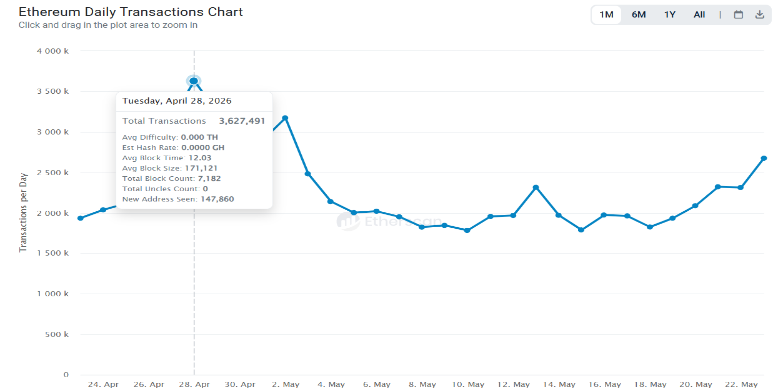
(Source: Etherscan)
According to on-chain data on Etherscan, the network has recorded around 3.6 million transactions on April 28, creating a new all-time high in the history of the Ethereum network. This large number of transactions has helped the network to record a high of over 72 million transactions in the entire month. The surge in network activity comes from the growing stablecoin and DeFi activities.
Despite the growth in network activities, Ethereum is also facing issues in order to generate efficient revenue. The fees paid by the users on the network and the burning of ETH tokens have dropped after the Dencun upgrade.
Recently, the former Ethereum Foundation researcher, Dankrad Feist, has proposed a new organization “that’s economically aligned with Ethereum.”
Despite the growth in the network, the Ethereum price is still consolidating between a tight range of around $2,100 to $2,250. At the time of writing this, the ETH price is hovering around $2,117 with a market capitalization of $255 billion, according to CoinMarketCap.
Also Read: SEC Delays Innovation Exemption for Tokenized Stocks